I Built an AI Legal Research App for Philippine Lawyers — And Here’s Everything It Can Do

📋 What’s in this post
Let me be honest with you — I’m not a lawyer. But I’ve spent enough time around Philippine legal professionals to know one thing: legal research in the Philippines is painfully slow. You’re digging through LawPhil, cross-referencing G.R. numbers, hunting for the right Supreme Court decision from 1987, and hoping your citations actually exist. It’s a lot.
So I built something. I called it JurisAI — an AI-powered legal research platform built specifically for Philippine lawyers. It runs on Claude AI (Anthropic), a PHP backend, MySQL, and vanilla JS. And after months of building, refining, and obsessing over anti-hallucination safeguards, I’m ready to talk about what it does.
I didn’t want to build just another chatbot wrapped around GPT. I wanted something that only answers questions it can actually verify — using real Philippine Supreme Court data.
The Problem I Was Trying to Solve
If you’re a Filipino lawyer or law student, you already know the pain. Jurisprudence research in the Philippines means manually searching databases, checking if a case is still good law, and spending hours just to build a solid legal argument. There’s no clean, modern tool that brings it all together — especially one that understands Philippine-specific legal context.
And the bigger fear with AI tools? Hallucinated citations. The last thing a lawyer needs is to file a pleading citing a Supreme Court case that never existed. I made that the #1 problem to solve from day one.

What JurisAI Actually Is
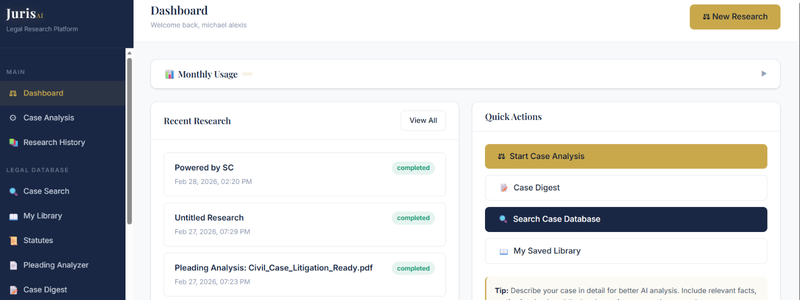
JurisAI is an AI-powered legal research platform built exclusively for Philippine law. It gives lawyers, law students, and professors a single place to analyze cases, search jurisprudence, review pleadings, generate digests, and even create bar exam questions — all grounded in verified Supreme Court decisions and Philippine statutes.
The tech stack is intentionally simple: PHP (vanilla), MySQL, Claude AI by Anthropic, and vanilla JS on the frontend. No bloated frameworks. Just a focused tool that does one thing extremely well: help Philippine legal professionals research faster and more accurately.
The database includes thousands of Philippine Supreme Court decisions, plus four major statutes fully indexed — the Civil Code, Revised Penal Code, Family Code, and Rules of Court. Every AI response is cross-checked against this database before it reaches the user.
The Core Feature: AI Case Analysis
This is the heart of JurisAI. You describe your legal case or scenario — at least 50 characters, so it has enough context — and the platform runs a full AI-powered legal research pipeline. What comes out is a structured brief that covers:
Key questions raised by the case, framed the way a lawyer would frame them.
Relevant statutes, codes, and specific provisions from Philippine law.
The strongest legal arguments supporting your client’s position.
Opposing arguments and potential weaknesses to prepare for.
Relevant SC decisions with G.R. numbers, holdings, and relevance scores.
Strategic legal advice based on the full analysis.
After you get your analysis, you can also ask follow-up questions — the AI remembers the full conversation context, so it’s a genuine multi-turn research session, not just a one-shot answer.
How I Tackled the Hallucination Problem
This is the part I’m most proud of — and the part I spent the most time on. AI models are notorious for making up case citations. They’ll invent a G.R. number, manufacture a holding, and present it with total confidence. In a legal context, that’s not just embarrassing — it could be professionally damaging.
Here’s how JurisAI handles it:
Anti-Hallucination Protocol: Any case the AI cites gets cross-referenced against the JurisAI database. If the G.R. number doesn’t exist in our verified records, the citation is either corrected from the database or removed entirely. Source URLs are never taken from the AI — they’re pulled directly from verified database records. Unverified citations don’t make it into your results. Period.
This applies to every AI-powered feature — case analysis, pleading analysis, doctrine timelines, and more. The same hallucination guard runs across all of them. It’s not perfect, but it’s significantly more trustworthy than raw AI output.
All the Features, Explained
📂 My Library — Your Personal Case Collection
You can bookmark any Supreme Court case from search results or AI analysis, organize them into custom folders, and add private notes. It’s your personal research library, always available whenever you need it.
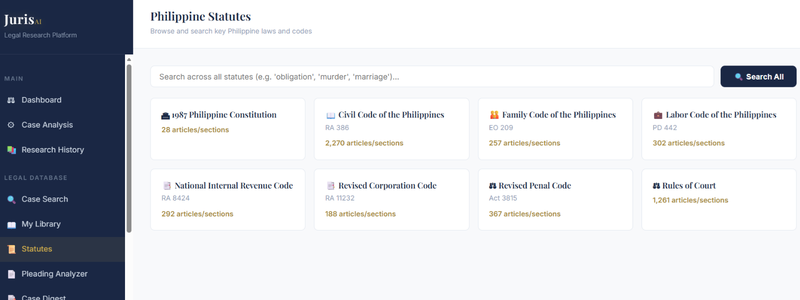
📖 Statutes Browser
Browse and search across four major Philippine statutes fully indexed in the platform — the Civil Code (2,270 articles), Revised Penal Code (367 articles), Family Code (257 articles), and Rules of Court (1,000+ sections). Every article includes structural metadata: Book, Title, and Chapter. These same articles are automatically pulled into AI prompts for grounding, so the analysis is always anchored in current statute text.
📄 Pleading Analyzer
Upload a PDF or paste a pleading, and JurisAI will review it end-to-end: document type, structural analysis, legal sufficiency, strengths and weaknesses, relevant jurisprudence, and an overall quality score. The same hallucination guard applies — every cited G.R. number gets verified before it shows up in the review.
✍️ Document Recreate
After the pleading analysis, you can request an AI-improved version of the document with all recommendations applied. One click — and you get a refined draft that preserves your original intent while fixing the structural and legal issues flagged in the review.
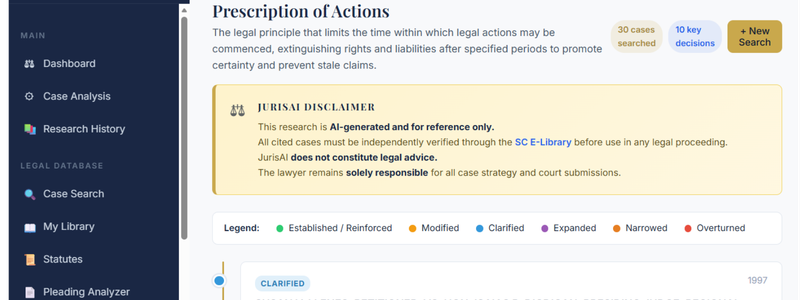
📅 Doctrine Timeline
This one is genuinely fascinating to use. Pick a legal doctrine, and JurisAI builds a chronological timeline of how that doctrine evolved through Philippine Supreme Court decisions. It searches up to 30 relevant cases, sorts them chronologically, and uses AI to analyze the doctrinal shifts — with every timeline event verified against the database.
📝 Case Digest Generator
Built for law students and professors — generate a full case digest in the standard Philippine law school format: Case Title, G.R. Number, Ponente, Facts, Issues (framed as “Whether or not…”), Held, Ratio Decidendi, Doctrine, and Keywords. You can save digests and retrieve them anytime.
🎓 Exam Generator
This one’s for law professors. Input your topic, difficulty level (Basic, Intermediate, or Bar Exam level), number of questions, and optionally a practice area or specific statute — and JurisAI generates complete exam questions with MCQ choices, model answers in IRAC format, grading rubrics, and cited laws and cases. The AI is grounded in actual statute text and real case law, not just general knowledge.
📤 Export to PDF
Every research session can be exported as a downloadable PDF — full analysis, cited cases, and follow-up conversation included. DOCX export is coming soon.
Who Is JurisAI For?
Honestly, I built it with three types of users in mind:
Practicing lawyers — especially solo practitioners and small firms who don’t have research associates and need to move fast. JurisAI compresses hours of jurisprudence research into minutes.
Law students — the Case Digest Generator and Doctrine Timeline are specifically useful here. Instead of spending an entire afternoon digesting one case, you can generate a full digest and spend your time actually understanding the doctrine.
Law professors — the Exam Generator alone makes JurisAI worth it. Generating bar-exam-quality questions grounded in real Philippine statutes and jurisprudence used to take significant time. Now it doesn’t.

Try JurisAI — Free to Start
JurisAI has a free plan that lets you explore the core features without a credit card. Paid plans unlock higher usage limits, more AI features, and full export capabilities. Registration takes under a minute — just your name, email, and optionally your IBP bar number.
I’ve put a lot into making this the most accurate, trustworthy AI legal research tool for Philippine lawyers available today. It’s not perfect — no AI tool is — but I’m genuinely proud of how far the hallucination safeguards have come, and I’m continuing to build.
If you’re a Filipino lawyer, law student, or professor, I’d love for you to try it and tell me what you think.
⚖️ Try JurisAI Free
AI-powered legal research built specifically for Philippine Supreme Court jurisprudence.
Get Started — It’s Free →